Business Christmas Cards: A Complete Guide for Companies
By Pure Greetings ·
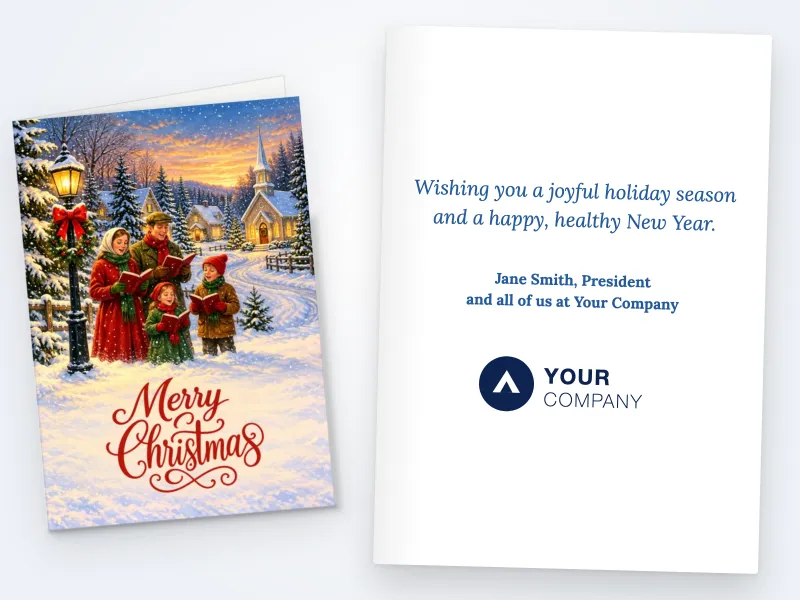
A printed card is one of the few business gestures that people still keep. It sits on a desk or a shelf through December, it gets passed around the office, and it says something an email can't: we thought about you, and we took the time. That's why business Christmas cards remain a December habit for companies of every size, from a five-person agency to a firm with thousands of clients.
This guide covers everything you need to plan your company's cards this year: who to send them to, how many to order, how to personalize them, what they cost, and when to order so they arrive on time. Already know what you want? Shop business Christmas cards with your logo and message, from 50 to 10,000 cards.
Why companies still send holiday cards
Corporate Christmas cards do three jobs at once:
- They thank clients. A card is a low-pressure way to say thanks for the year's business, with no pitch attached.
- They keep your name in front of people. A well-designed card with your logo stays visible for weeks, which is more than most marketing can claim.
- They recognize your own team. A card signed by leadership is a small but real gesture for employees, especially remote ones.
The key is that the card has to feel like a greeting, not an advertisement. That means a beautiful front, a warm message inside, and branding that's present but quiet. More on that in our guide to business holiday cards with your logo.
Who should get a company holiday card?
Start your list early, because the list sets your quantity, and your quantity sets your price. Most businesses pull from these groups:
- Clients and customers, especially repeat and high-value accounts.
- Prospects you've had real conversations with this year.
- Partners, vendors and referral sources, who rarely get thanked.
- Employees, either mailed home or handed out with a note.
- Your local community: the landlord, the building staff, the bank branch, the coffee shop that knows your order.
Export contacts from your CRM, remove duplicates, and ask each manager or account lead to add anyone they personally want to thank. Then add 10 to 15 percent for late additions and mistakes. Running out in mid-December is far more expensive than having a few cards left over.
Choosing a design
The front of the card does the heavy lifting. A few guidelines for corporate holiday cards:
- Pick artwork, not stock photos. Illustrated scenes feel warmer and more personal, and they're far less likely to look like every other card on the desk.
- Keep it timeless. Classic scenes like snowy villages, a Christmas tree lot or carolers suit almost any industry and won't look dated next year.
- Match your audience. A law firm and a landscaping company can send the same card, but the greeting and inside message should fit who's receiving it.
Our business Christmas cards are built around original vintage-style artwork: town squares, classic trucks, farmhouses and carolers, each available with the greeting of your choice. If you're drawn to that nostalgic look, see our vintage Christmas cards.
Merry Christmas or Happy Holidays?
For a mixed list of clients, many companies choose an inclusive greeting like Happy Holidays or Season's Greetings. Others send Merry Christmas because it reflects who they are. Neither is wrong, and our guide to choosing a greeting walks through how to decide. You can browse every design by greeting on our holiday cards by greeting page.
Personalizing the inside
The inside is where a card stops being generic. At minimum, include:
- A short holiday message (two or three lines is plenty).
- Your company name and logo.
- A signature line: the founder, the leadership team, or "everyone at" your company.
Want your logo on the front too? See how placement works on our holiday cards with your logo page. If you're stuck on wording, we've collected 100 business holiday card messages for clients, employees and partners. And if you have time, a handwritten signature or a one-line personal note on your most important cards makes a printed card feel personal.
How much do business Christmas cards cost?
The price per card drops quickly with quantity, so it pays to order everything for the year at once rather than in small batches. Here's what one design costs at Pure Greetings today:
| Cards | Total | Per card |
|---|---|---|
| 50 | $80.78 | $1.62 |
| 100 | $148.78 | $1.49 |
| 250 | $347.05 | $1.39 |
| 500 | $388.26 | $0.78 |
| 1,000 | $500.99 | $0.50 |
| 2,500 | $866.90 | $0.35 |
| 5,000 | $1,435.37 | $0.29 |
| 10,000 | $2,765.67 | $0.28 |
Current Pure Greetings prices for one design, with envelopes and free ground shipping.
Every pack comes with white A7 envelopes, and ground shipping is free. Smaller companies can start with 25 cards; larger ones get volume pricing up to 10,000 cards. For bigger or more complex orders, you can request a quote.
When to order company Christmas cards
Timing is the most common mistake. Your cards need time to be printed and delivered to you, and then you need time to sign, address, stamp and mail them, and the mail needs time to deliver them. Work backwards:
- Early November: finalize your list and choose a design.
- By December 1: order if you plan to sign and mail the cards yourself. That leaves time for printing, shipping, signing and the post office.
- By December 9: the last day to order with free ground shipping for delivery to you before Christmas.
- By December 14 or December 15: the last days with 2 Day Air or Next Day shipping.
Cards usually print within 4 business days after our review. Delivery times are carrier estimates, so earlier is always safer. If December gets away from you, a Happy New Year card sent in early January is a perfectly good alternative, and it stands out because fewer people send them.
Mailing tips
- Address by hand where you can. Handwritten envelopes get opened. Printed labels can look like bills.
- Use real stamps. A holiday stamp beats a postage meter strip.
- Send to the person, not the company. A card addressed to "Accounts Payable" won't do much for anyone.
- Mail in the first half of December. Cards that arrive early stay up the longest.
A quick checklist
- Build and clean your recipient list, plus 10 to 15 percent extra.
- Pick a design and a greeting that suit your audience.
- Write a short inside message and choose who signs.
- Upload your logo and check the preview.
- Order by December 1 if you're signing and mailing yourself.
- Sign, address and mail in early December.
That's it. A little planning in November turns into a card your clients and team will actually keep. When you're ready, choose your company Christmas card design and see a live preview with your logo before you order.